
The optimal electrode-diaphragm gap

We previously demonstrated (here) that, counterintuitively, moving your electrodes further apart can sometimes decrease the ohmic resistance. A small 0.2 mm gap between a perforated electrode and the diaphragm was found to increase energy efficiency compared to a zero-gap configuration. The reason is that a small gap allows electrolyte flow and gas bubbles to escape more easily.

A natural next question is, what is the optimal value of this gap? We found that a 0.06 mm gap still gives slightly better results than a 0.2 mm gap. Smaller values are unlikely to be significantly better, since bubbles are of this size and are likely to get trapped.
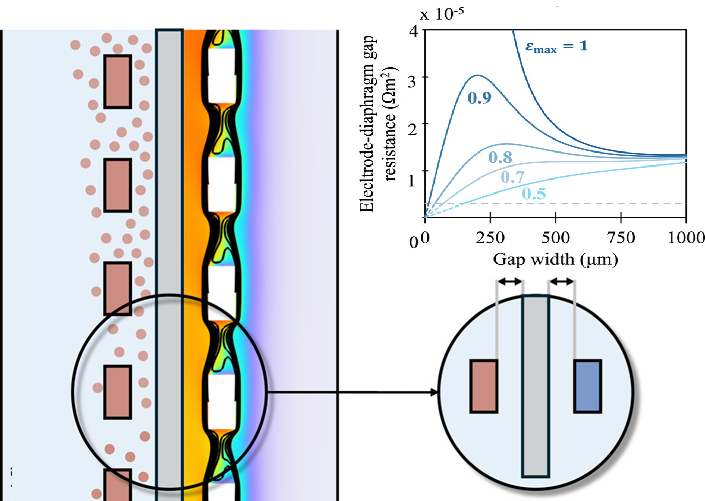
For longer distances, we found that multiphase computational fluid dynamics simulations were in good agreement with our experiments. We even developed an approximate analytical model of the gas fraction and resistance as functions of the gap distance and height. This surprisingly simple model allows for estimating how much the current density will decrease as a function of height.
van der Does, W. L., Valle, N., & Haverkort, J. W. (2026). Bubble resistance in near-zero-gap alkaline water electrolysis. Electrochimica Acta, 148509.

Pulsed Water Electrolysis usually worse compared to DC

An often mentioned simple way to improve water electrolysis is to modulate the current, for example, by rapidly switching it on and off periodically. Many papers report improvements without a fair comparison with the non-modulated (DC) case. In such a comparison, the same amount of hydrogen is produced per unit time, so that the average current over time is equal.

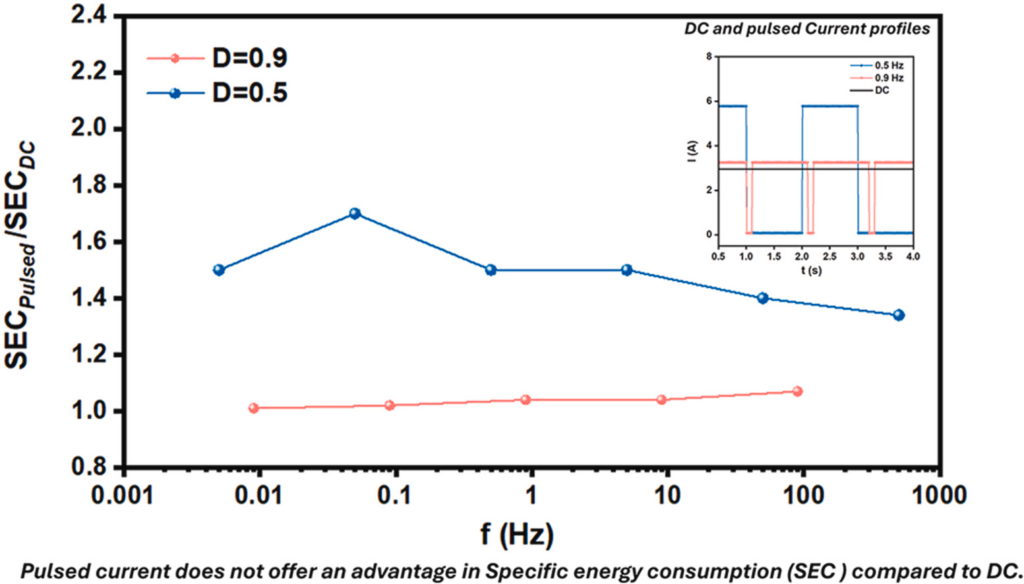
Unfortunately, doing exactly this, we found no positive effect of modulating the current in the 0.01-1000 kHz range.

This is easy to understand, because energy losses usually increase more than linearly with current density: to obtain the same average current density, the lower energy losses at lower-than-average current are more than offset by the higher energy losses during periods of higher-than-average current.

There are a few noteworthy exceptions: for example, at low currents, the stack losses can decrease with increasing current density due to shunt currents. Also, by modulating at the time scale of gas build-up, a small advantage may be obtained. Finally, there may be a regime at extremely high frequencies at which the catalysis will be influenced. However, in general, claims of improvement should be considered with healthy scepticism.

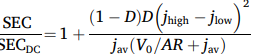
For a cell voltage V0+ARj, the larger the difference between the high current (jhigh) and low current (jhigh), and the larger the fraction of the time D or 1-D that the current is high or low, the higher the specific energy consumption (SEC) compared to DC (jav) :

This prediction was nicely validated by in-house experiments with an AEM cell.

Anamika Ghosh, J.W. Haverkort, Modulating the current in water electrolysis does not increase energy efficiency compared to a constant equal average current, International Journal of Hydrogen Energy, Volume 221, 2026, 154195